
Switzerland just voted against a population cap. Malta should pay close attention.
On June 14, 2026, Swiss voters were asked to decide on one of the most unusual referendum questions in recent European democratic history: should Switzerland’s population be legally capped at 10 million people by 2050? The proposal, championed by the Swiss People’s Party (SVP), would have enshrined into law a requirement that the permanent resident population not exceed that ceiling. A lower trigger at 9.5 million would have compelled the government to begin restricting immigration through tighter rules on asylum, family reunification, and residency permits. If the population reached 10 million for two consecutive years, Switzerland would have been constitutionally required to end its free-movement agreement with the EU, which is its largest trading partner, accounting for more than half of Swiss exports.¹
Nearly 55% of Swiss voters rejected the proposal. But the 45% who supported it is not a fringe position, and it will not disappear because this particular instrument failed. For anyone paying attention in Malta, both the debate and the result deserve careful study.
”Our small country is bursting at the seams”
The SVP’s campaign language was striking in its directness. “Our small country is bursting at the seams,” the party declared. “Nature is being paved over. There are ever more traffic jams on the roads, overburdened public transport, overburdened schools, housing shortage and rising rents, massively increasing crime and exploding costs for Swiss taxpayers.”²
Strip away the Alpine geography and this reads like a transcript of any number of conversations happening in Malta right now. Housing costs that have outpaced wages. Roads that cannot absorb the traffic they carry. A sense, widely shared and rarely quantified, that the country has grown faster than its infrastructure can absorb. The rhetorical overlap is not a coincidence. It reflects a structural pattern that both countries share in ways that are rarely stated precisely.
Two small countries, one structural story
The parallels between Malta and Switzerland are worth establishing with some precision.
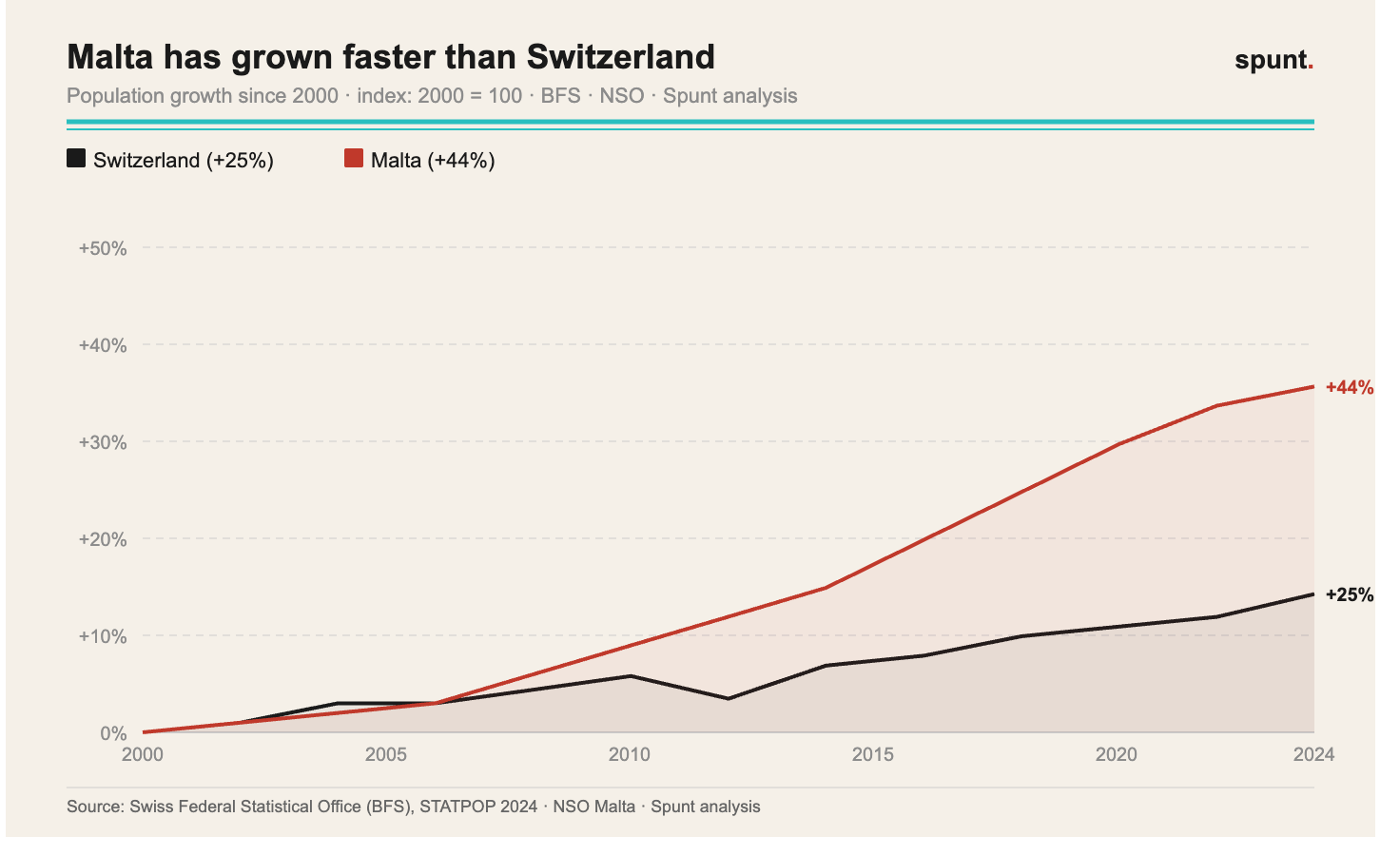
Switzerland’s population stood at 9.1 million at the end of 2024, having grown from 7.2 million in 2000, an increase of 25% over 24 years, driven predominantly by immigration rather than natural increase.³ Malta’s population grew from approximately 390,000 in 2000 to around 560,000 in 2024, a growth rate of roughly 44% over the same period, on an island with no room to expand outward.
Both countries now have foreign-born populations of approximately 26–28% of total residents, and both among the highest shares in Europe, comparable only to Luxembourg, and well above the EU average of around 10%.⁴ The OECD has noted that Switzerland’s foreign-born share, at 32% as of 2024, ranks behind only Luxembourg and Australia among its 38 member countries.⁵
And here is the number that almost never appears in Malta’s immigration debate: Malta’s population density is approximately 1,772 people per square kilometre. Switzerland’s is 220 people per square kilometre, and they are the country whose citizens felt sufficiently crowded to put a population cap to a national vote.
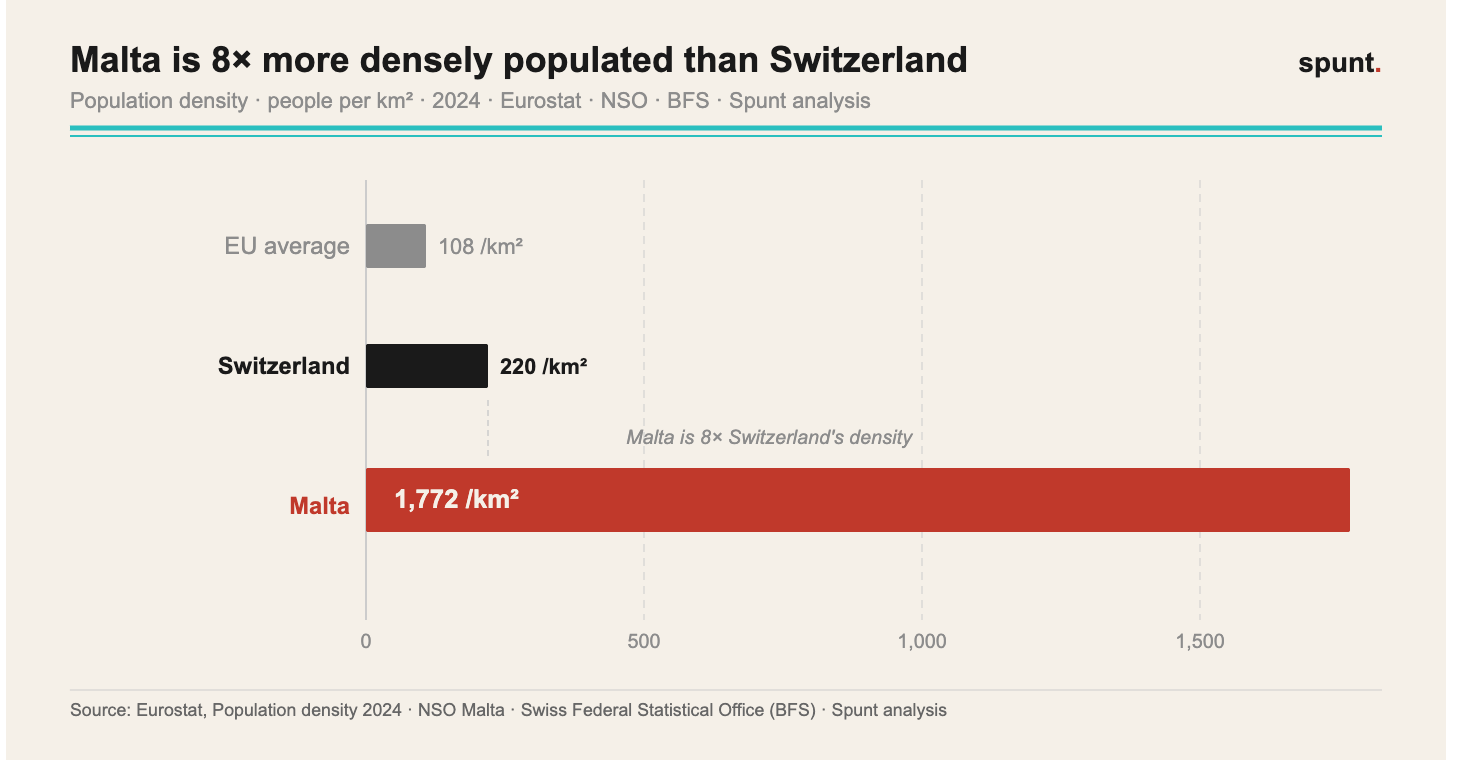
This means that Malta is eight times more densely populated than Switzerland. And if the Swiss, at 220 people per km², consider their country to be bursting at the seams, how should the Maltese feel? The question is not a rhetorical one. It is an empirical one that deserves a serious answer.
Why the Swiss rejected the cap — and what that tells us
Polling firm GFS Bern, one of Switzerland’s leading political research organisations, was clear about why the initiative failed. Urs Bieri, a senior analyst, explained that voters shared the underlying concern about population growth but were unconvinced by the plan and worried about its side-effects. “Voters were worried about negative consequences for Switzerland’s relationship with the EU and for the labour market,” he said. “People are also worried about things like having enough care and health workers. Also, there’s a feeling that in the current international environment it’s not sensible for a small country to do this.”⁶
Three specific objections carried the day: the risk to EU relations, the risk to labour market access, and the fear of losing care and health workers. These are not abstract economic concerns. They are immediate and relevant. The fear of losing a nurse or a care worker is more vivid and proximate than the diffuse benefit of slower population growth.
But the 55% who voted against were not voting against the concern. They were voting against this particular instrument. The distinction matters enormously. A 55–45 result in which the majority shares the underlying anxiety but rejects the proposed mechanism is very different from a 55–45 result in which the majority simply disagrees with the premise. The SVP won the emotional argument and lost the policy argument simultaneously.
Swiss Justice Minister Beat Jans welcomed the result but pledged to analyse “what further steps could be taken to satisfy voter concerns about housing and immigration.” The question, in other words, has not been answered. It has been deferred.⁷
What the data shows about Swiss immigration
The political framing of the referendum, as with most European immigration debates, implied a specific demographic target, the kind of non-Western European arrivals that dominate political imagery around migration. The data tells a more complicated story.
Analysis of Swiss Federal Statistical Office integration indicators reveals that more than 70% of Switzerland’s employed foreign labour force works in mid or low-skill roles such as in hospitality, construction, domestic services, and elementary occupations. Switzerland is not primarily importing talent. It is importing labour.
This is visible in the wage data. Among first-generation migrants from Southwest Europe (Italy, Portugal, and Spain) the share earning below two-thirds of the Swiss median wage stands at 27.9%, compared to 13.9% for native Swiss workers. Among Eastern and Southeastern European migrants the figure is 29.0%, and among non-European workers it reaches 40.7%.⁸ These are not marginal differentials. They indicate structural concentration in substitutable, lower-wage work.
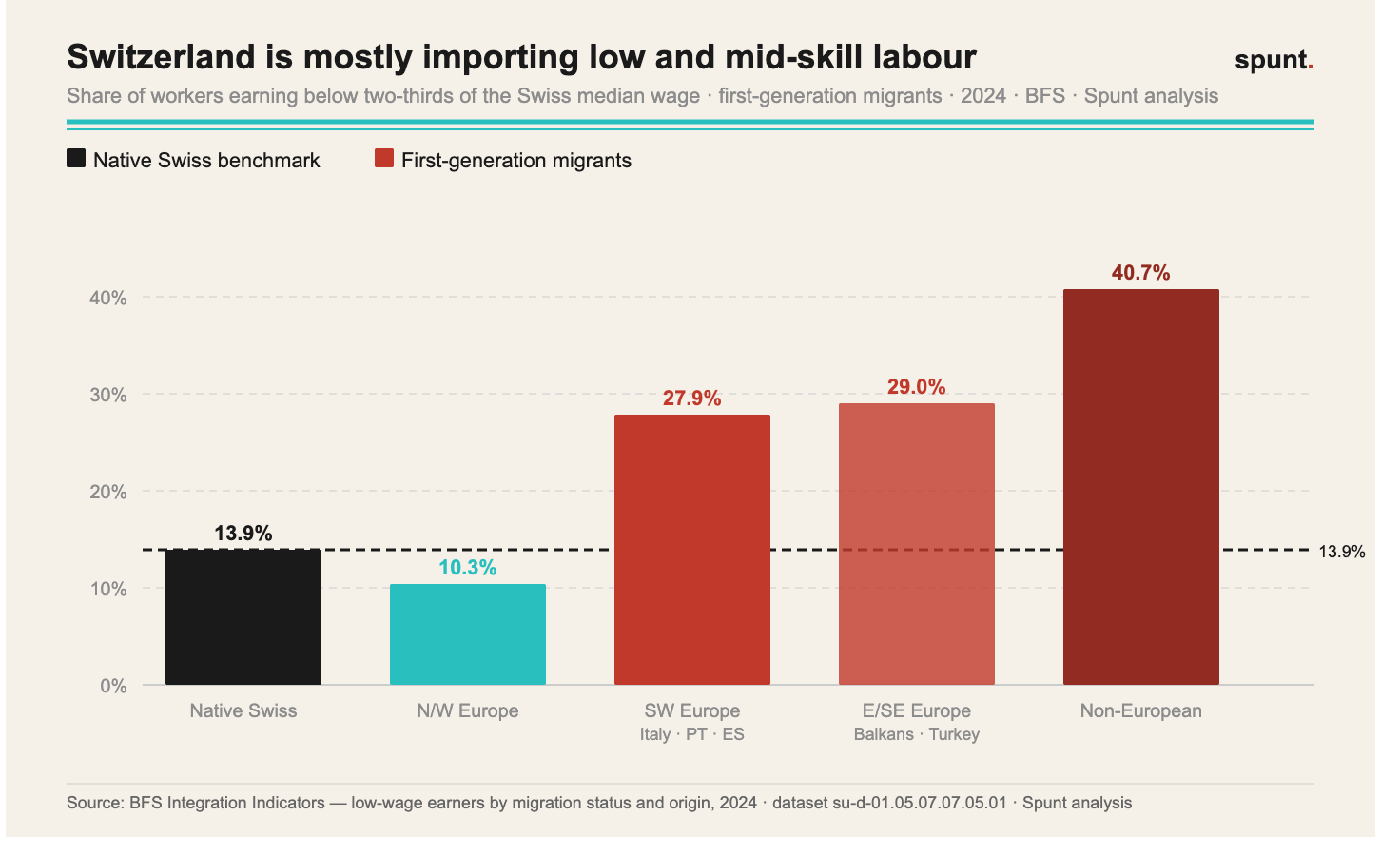
The irony at the heart of the referendum is that the Swiss immigration flows most likely to push the country toward its 9.5 million trigger are overwhelmingly European (Germans, Italians, Portuguese, French) arriving under EU free-movement agreements that the SVP cannot legally target. The mechanism was a blunt headcount ceiling applied to a demographically heterogeneous population that required at minimum four or five different analytical frames.
Swiss voters, to their credit, recognised this. The 55% who voted no were not saying the problem does not exist. They were saying this solution was not ready.
Remember Alfred Sant’s vision?
Alfred Sant, as Prime Minister, once described Malta’s ambition as becoming a Switzerland of the Mediterranean — a small, open, prosperous economy competing on quality and sophistication rather than cost. The irony of 2026 is that the convergence between the two countries has arrived, but not as he imagined.
Malta has matched Switzerland’s foreign-born population share. It has matched its immigration-driven growth rate. It has produced the same public discourse about crowding, housing, and infrastructure strain. What it has not matched is the high-skill, high-productivity economy that makes the costs of density worth bearing.
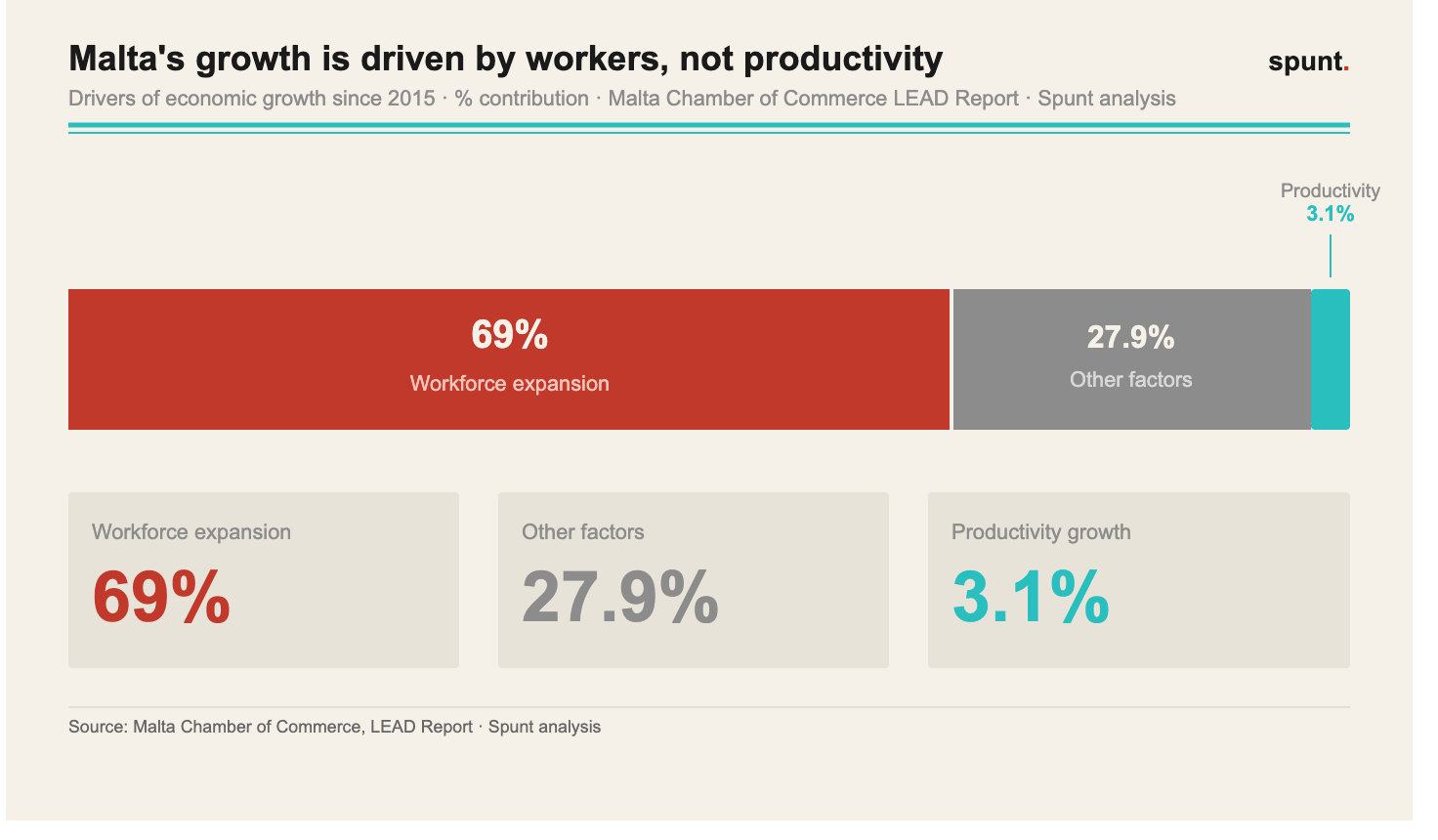
The Chamber of Commerce LEAD report provides the sharpest quantification of this gap: only 3.1% of Malta’s economic growth since 2015 has come from increased productivity. A full 69% has come from an expanding workforce.⁹ Malta’s growth model is almost entirely input-driven, that is, it has been driven by more workers and more hours, rather than efficiency-driven. The economy has grown by importing labour rather than by becoming more productive with the labour it already has.
The economic argument neither debate has confronted
Here is what both the Swiss and Maltese debates have so far failed to ask directly: what if easy access to cheap labour is not merely a symptom of the problem, but a cause of it?
Nobel prize-winning economists such as Daron Acemoglu, whose 2024 Nobel Prize recognised his work on how institutions and incentives shape long-run economic outcomes, have long observed that when labour is cheap and abundant, firms have a reduced incentive to invest in the technology, automation, and capital that drive productivity growth. The marginal cost of adding another worker is lower than the marginal cost of investing in the software or machinery that would replace them. So firms hire rather than innovate. Economies grow by accumulating inputs rather than by becoming more efficient.
Input-driven growth has a ceiling. Total factor productivity (doing more with the same) does not. A country that can always find another worker has less reason to build the machine that replaces one, and less reason to train the workforce that operates it.
This is not an argument for or against immigration per se. It is an observation about the structure of incentives that cheap, abundant labour creates, and about what that structure means for the long-run trajectory of a small, open economy that aspires to compete on quality rather than cost.
Neither Switzerland nor Malta has yet reckoned seriously with this argument. The Swiss debate focused on headcount and EU relations. The Maltese debate, to the extent it exists, focuses on housing and traffic. Both are treating the symptom. Neither is asking whether the underlying economic model is what needs to change.
Watch and learn
Malta does not need to copy Switzerland. But the Swiss experiment is rare and valuable precisely because it is happening in a country with comparable characteristics.
Over the next several years, the Swiss case will continue to generate evidence on questions that matter for Malta. Does constraining labour supply in specific sectors push firms toward automation and capital investment, or does it lead to contraction and price increases? Does the Swiss government’s pledge to take further steps on housing and immigration produce credible alternatives?
These are not Swiss questions. They are questions about the economics of small, open, immigration-dependent economies, precisely what Malta is. The Swiss experiment will not produce answers that translate directly to a Maltese context. But it will produce evidence. And evidence, in a debate that has so far generated more heat than light, is not nothing.
Malta would do well to pay attention.
References
-
CNN, ‘Swiss reject population cap in referendum, avoiding EU clash and cheering business’, June 14, 2026. https://www.cnn.com/2026/06/14/europe/swiss-voters-population-referendum-intl
-
Swiss People’s Party (SVP), official campaign statement, February 2026. Cited in Fox News, ‘European nation votes to cap population at 10M’, February 12, 2026. https://www.foxnews.com/world/european-nation-votes-cap-population-10m-major-immigration-crackdown-referendum
-
Swiss Federal Statistical Office (BFS/FSO), Population change and vital statistics in 2024: Provisional figures, April 2025. https://www.bfs.admin.ch/news/en/2025-0336
-
Swiss Federal Statistical Office (BFS/FSO), STATPOP 2023. Wikipedia, Demographics of Switzerland. https://en.wikipedia.org/wiki/Demographics_of_Switzerland
-
Al Jazeera, ‘Switzerland rejects right-wing bid to cap country’s population’, June 14, 2026. https://www.aljazeera.com/news/2026/6/14/switzerland-votes-on-right-wing-bid-to-cap-countrys-population
-
Urs Bieri, GFS Bern, quoted in Reuters / Global Banking and Finance Review, June 14, 2026. https://www.globalbankingandfinance.com/switzerland-votes-proposal-cap-population-10-million/
-
Swiss Justice Minister Beat Jans, press conference, June 14, 2026. Cited in CNN, op. cit.
-
Swiss Federal Statistical Office (BFS/FSO), Integration Indicators — Share of low-wage earners by migration status, various socio-demographic characteristics and major regions, 2013–2024. Dataset: su-d-01.05.07.07.05.01.xlsx.
-
Malta Chamber of Commerce, LEAD Report, productivity and workforce growth data since 2015.