
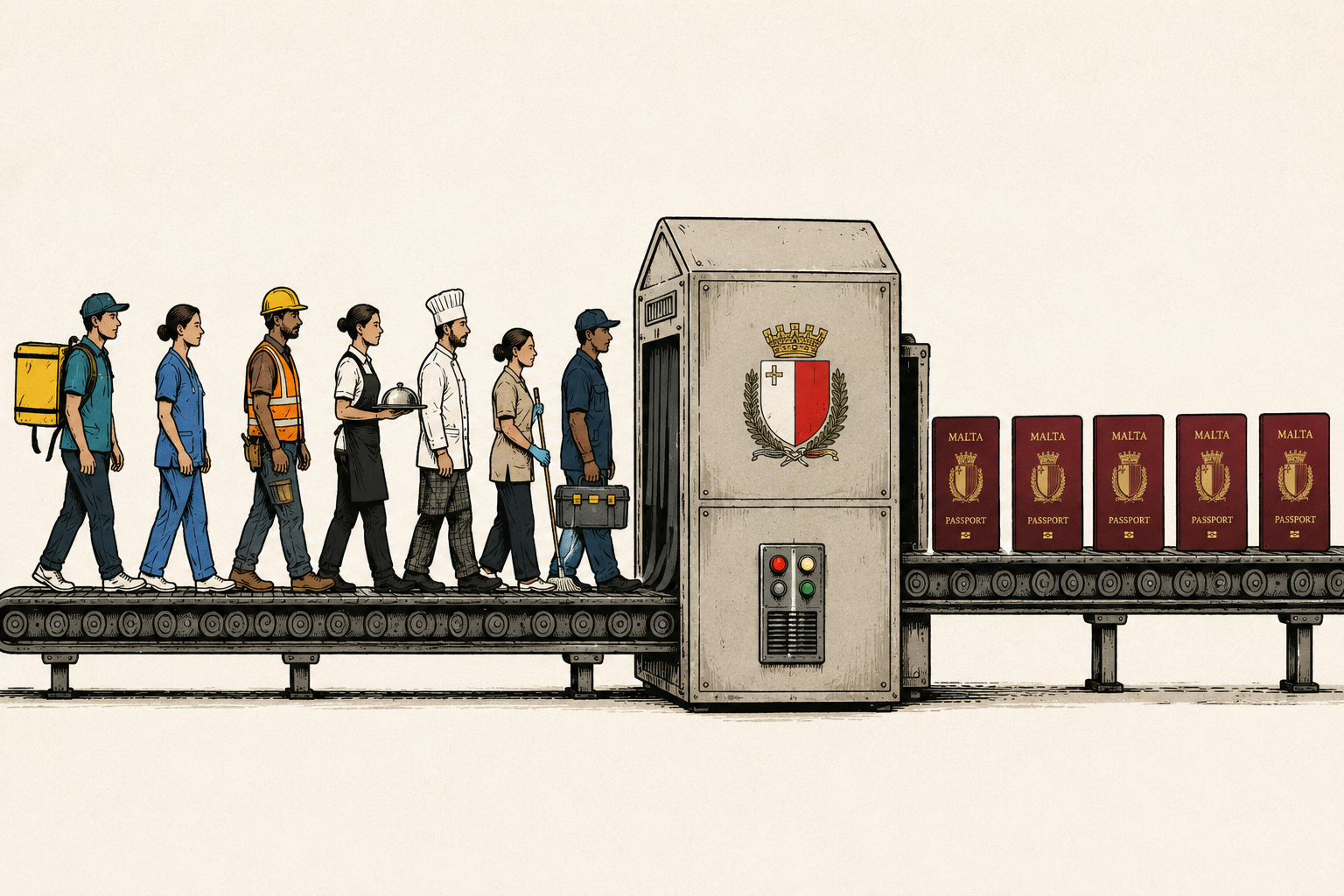
The Naturalisation Wave No One’s Talking About
Something significant is building in Malta, and it is happening quietly.
Over the past few years, the country has absorbed tens of thousands of foreign workers into its economy. By 2023, more than 28% of Malta’s population was of foreign nationality, most of them of working age. In sectors like hospitality and food services, foreign workers are no longer a supplement to the system. They are the system.
They were brought in to fill labour shortages and sustain growth. In practice, Malta has been operating something close to a guest worker model, even if it has never formally described it as such.
But legally, these workers are not temporary.
The five-year threshold
After five years of legal residence, a third-country national can apply for Maltese citizenship. In the near future, Malta is likely to see a substantial increase in naturalisation applications as a direct consequence of how the system is designed. And yet, there has been no real national conversation about it.
Historical trends in Malta show a high churn rate among foreign workers, with a median stay of around 3 years, and about 50% leaving within that period. As a result, relatively few have so far crossed the five-year residency threshold typically associated with long-term settlement or eligibility pathways. However, this outcome is largely incidental rather than the product of deliberate policy design.
So long as the current visa framework remains unchanged while demand for foreign labour persists, Malta may increasingly face a build-up of longer-term residents, raising the prospect of a future wave of naturalisations. While several countries are tightening access to long-term residency and citizenship, Malta could also become a perceived easier pathway to an EU passport for foreign workers.
A shrinking demographic base
Malta’s fertility rate has fallen to around 1.0–1.1 children per woman, one of the lowest in the EU and far below the replacement level of 2.1. Fewer Maltese are being born, while the total population continues to grow through immigration at one of the highest rates in the European Union. In a country of just over half a million, this is a deep and structural change.
From labour force to electorate
Citizenship means full participation in public life, voting, influencing elections and ultimately shaping the country’s future. In Malta, where elections are decided by narrow margins, even small changes in the electorate carry political consequences.
This creates a structural tension. Workers are treated as temporary when they arrive, but the legal framework treats them as future citizens. The transition from labour to electorate has never been openly debated. It is simply built into the timeline.
Maltese voters were never asked whether they see immigration as a temporary labour solution or a long-term population strategy. In practice, the system is delivering the latter.
A system designed without a strategy
Malta’s system does not distinguish between people who come to settle permanently and those who come primarily to work. A five-year residency threshold effectively turns a temporary labour policy into a citizenship pipeline. If workers are being brought in to fill economic gaps, the model should reflect that.
That could mean clearer separation between temporary work permits and permanent residency, stricter naturalisation criteria, or longer timelines that prioritise genuine integration over simple duration of stay. Otherwise, Malta will inadvertently be reshaping its future population without ever having consciously decided to do so.
A proven alternative: the guest worker model
Malta is not the first small, prosperous territory to grapple with heavy dependence on foreign labour. Singapore offers a clear precedent. A small, densely populated city-state with limited natural resources, it has depended heavily on foreign labour for decades, yet has never allowed that dependence to blur the line between working in Singapore and becoming Singaporean.
Foreign workers are admitted on tiered permits with defined terms and renewal conditions. Permanent residency and citizenship are granted selectively, based on strategic value and demonstrated integration, not as an automatic consequence of time served. Singapore’s national identity and political structures remain firmly in the hands of its citizens.
Japan also runs a Specified Skilled Worker programme, bringing in workers on one- or two-tier visas, capped at five years with no family reunification and no direct path to permanent residency.
Adopting a defined-term worker model would not require Malta to close its doors. It would simply require the state to decouple “who works here” from “who becomes Maltese.” Workers could be brought in on renewable two- or three-year contracts, while those who demonstrate exceptional integration or fill critical long-term skills gaps could still be offered a pathway to citizenship as a deliberate selection rather than a demographic accident.
The conversation Malta isn’t having
Migration continues to be treated as an economic input question. The long-term demographic implications (naturalisation, population balance, electoral impact) are rarely addressed in a cohesive and coherent way. The declining birth rate is acknowledged but not meaningfully reversed.
Establishing a clearly defined visa system with fixed time limits for temporary workers reduces uncertainty around long-term settlement and citizenship pathways.
By removing an automatic progression to citizenship, it reassures local populations that foreign workers are present only temporarily. This clarity helps ease social tensions by aligning expectations. At the same time, it gives policymakers flexibility to adjust or reverse immigration policies without long-term demographic commitments, creating a more controlled and transparent framework for managing foreign labour.
As things stand, the question Malta faces is not whether change is coming, but whether it will be shaped deliberately or allowed to unfold by default.
At the moment, it is doing the latter.
Sources:
- Komunità Malta – Acquisition of Citizenship: komunita.gov.mt/services/acquisition-of-citizenship
- Maltese Citizenship Act, Cap. 188, Article 10(1)
- ACC Malta Immigration – Citizenship by Naturalisation: maltaimmigration.eu/malta-citizenship/malta-citizenship-by-naturalisation