
Three of Malta’s Ministries Exist Nowhere Else in Europe — Here’s How We Know
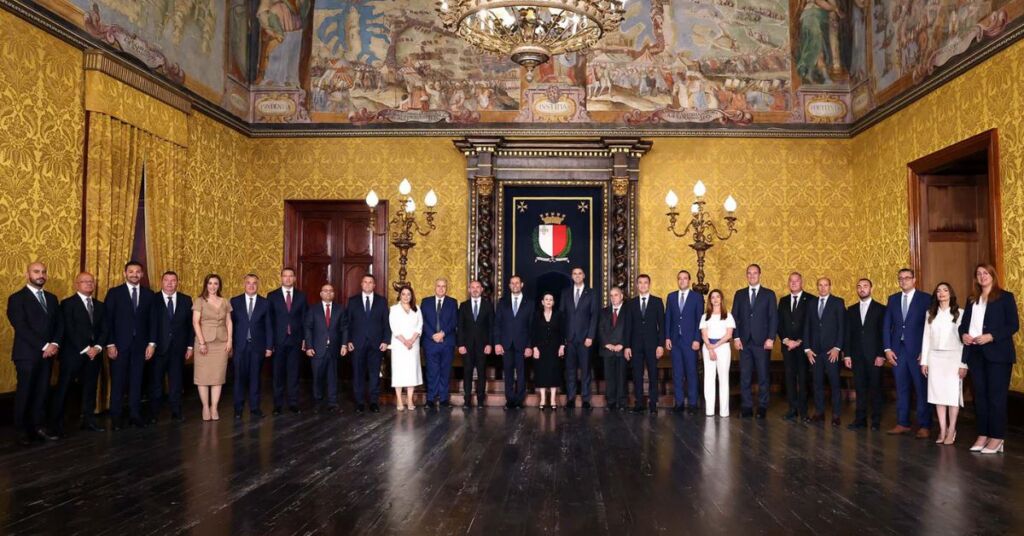
Every new government reshuffles the cabinet, and every reshuffle produces a fresh crop of ministry names — some familiar, some oddly specific. Malta’s current cabinet runs to 21 ministries covering 45 distinct mandates, several of which sound like they were drawn up for a single press release rather than a standing department of state. So we asked a simple question: how does Malta’s cabinet compare with the rest of Europe’s?
To find out, we took each of Malta’s 45 ministerial mandates — from Finance and Foreign Affairs down to Voluntarism and Grand Harbour Regeneration — and checked how many of the other 37 European countries’ cabinets include something equivalent. Some titles travel under different names in different countries (what Malta calls “Home Affairs” might be “Interior” elsewhere), so we matched on function rather than label. The result is a prevalence score for every mandate: the share of Europe that thinks this job needs its own minister.
The pattern that emerges is not subtle. Malta’s cabinet is simultaneously crowded with portfolios that exist almost nowhere else, and missing a small number that exist almost everywhere else.
Eleven of the 45 mandates are about as uncontroversial as government gets — Finance, Foreign Affairs, Education, Home Affairs, Agriculture, Justice, Social Policy, Economy, Health, Transport and Environment. At least 84% of Europe gives each of these its own ministerial portfolio, and several sit at a clean 100%. These are the load-bearing walls of any cabinet, and Malta’s are exactly where you’d expect them.
The Middle Ground
Below that top tier, things get more interesting. A further eight mandates — Infrastructure, Employment, Energy, Culture, European Affairs, Fisheries, Security and Local Government — are “common” rather than universal, found in 16 to 28 of the 37 countries (43–76%). These are still mainstream choices, the kind of portfolio a mid-sized European country could plausibly carve out on its own, even if a smaller cabinet might fold them into a larger ministry instead.
Eleven more sit in “moderate” territory, found in 9 to 15 countries (24–38%): Sport, Tourism, Research, Public Works, Family, Youth, Consumer Protection, Innovation, Equality, Accommodation/Housing and National Heritage. Some of these — Tourism in particular — make obvious sense for Malta given the size of the industry relative to the economy, even if most of the continent manages without a dedicated tourism minister. Others, like Youth or Equality, are more often folded into Education or Justice elsewhere. The less common a mandate is, the harder it becomes to justify as a standalone ministerial brief rather than a unit within a larger department.
“When less than half of Europe sees the need for a ministry, the question stops being whether Malta is wrong to have it — and starts being whether it needs to be a ministry at all.”
Ten Mandates Most of Europe Does Without
Then there is a tier of ten mandates found in only 1 to 8 of the 37 countries (3–22%): Technology, Food/Food Supply, Planning (Spatial), Arts, European Funds, Inclusion, Lands, Social Dialogue, Civil Rights and Strategic Projects. Most of Europe handles each of these — to the extent it handles them at all — as a directorate or junior portfolio nested inside a bigger ministry, not as its own ministerial chair. In Malta, each one comes with its own minister, office, and budget line.
Five Mandates That Exist Nowhere Else in Europe
At the very bottom are five mandates that we could not match to any of the other 37 countries at all: Wellbeing, Voluntarism, Electoral Programme Implementation, Grand Harbour Regeneration, and Gozo. Three of these five have no European equivalent whatsoever as standalone ministries — Wellbeing, Voluntarism, and Electoral Programme Implementation are mandates that, as far as we could find, exist in no other European cabinet in any form.
The other two — Gozo and Grand Harbour Regeneration — are regional development mandates, and regional ministries do exist elsewhere, just very rarely. The closest comparisons are the UK’s territorial offices for Scotland, Wales and Northern Ireland, and Denmark’s minister for Greenland and the Faroe Islands. Gozo accounts for roughly 6.3% of Malta’s population — smaller than Scotland’s 8% share of the UK, but larger than Wales (4.6%) or Northern Ireland (2.8%). On a population basis, then, a Gozo ministry is at least in the same conversation as those examples. Grand Harbour Regeneration has no such parallel: it is a mandate built around a specific construction and heritage programme in a specific part of the country, with no equivalent anywhere in the dataset.
What’s Missing
The mirror image of all this is just as telling. Malta does not have a Defence ministry, despite 92% of Europe — 34 of 37 countries — having one, at a moment when security concerns across the continent are rising rather than falling. And Malta has no minister with clear, sole accountability for migration — consistently one of the top concerns in Maltese public opinion polling — even as it has five ministers with mandates that exist in zero other European cabinets between them.
The Bigger Picture
Put together, the numbers describe a cabinet that is bloated in political portfolios and thin in functional ones. Eleven mandates have no parallel in at least 29 of Europe’s 37 cabinets, and five have no parallel at all — while two of the mandates most of Europe treats as essential are absent from Malta’s cabinet entirely. Whatever the merits of any individual ministry, the overall shape of the cabinet looks less like a response to Malta’s needs and more like a response to its politics.