
The Flexibility Debate Malta Needs — But Isn’t Quite Having
Before this election campaign, Alex Borg had already made headlines for the wrong reasons, at least in the eyes of his political opponents. Back in October 2025, the Nationalist Party leader proposed trialling a four-day working week in certain public sector departments, with a view to extending it to the private sector through incentives if the results proved positive. The reaction from the government was swift and dismissive.
Finance Minister Clyde Caruana was blunt: “When productivity goes up, I would consider it, but not now.” Shortly after, in December, Marisa Xuereb, former Chamber of Commerce president and seasoned entrepreneur, offered a different angle: “Most workers are productive for five hours a day anyway,” she said, suggesting a five-hour workday might be sufficient. The idea, at least according to Minister Caruana, was reckless populism.
Fast forward six months, and Prime Minister Robert Abela is standing on a stage in Castille Square on Workers’ Day, pledging that a re-elected Labour government would open discussions with social partners to give workers the right to request remote working, flexi-time, or a compressed working week with financial support offered to employers who accept. The flexibility debate, it turns out, was not reckless as Caruana had argued. In the eyes of the Prime Minister, it was simply ahead of schedule.
This is now, formally, an election issue. Both major parties have staked out positions on how Maltese workers should be able to organise their time. As we will see, the industry has expressed concern, while being silent on its failures. Furthermore, what is largely missing from the conversation is what the data actually says about who stands to benefit, and who does not from these proposals.
Four proposals, not one
Before examining the evidence, it is worth being precise about what is actually being proposed, because the political debate has blurred some important distinctions.
Remote working is about location. You work the same hours, the same days, just not at the office. Flexi-time is about timing. Simply put, with flexi-time, your total hours are unchanged, but you have discretion over when you start (and when you end) your working day. A compressed working week redistributes your full contracted hours across fewer days. For example, four ten-hour days instead of five eight-hour ones. You work less days, and still work forty hours, but Friday is free.
The four-day working week, as trialled in Iceland, the United Kingdom, and Portugal, is categorically different. It means working four days for the same pay as five, with no expectation of longer hours. Total working time falls, typically from forty to thirty-two hours, and the bet is that productivity gains compensate for the reduction. This is the model Borg proposed, at least in pilot form. It is not the same thing as a compressed week, though the two are routinely conflated.
When Abela speaks of a “compressed week” alongside remote working and flexi-time, he is proposing flexibility without any reduction in labour input. When Borg speaks of a four-day week, he is (at least in principle) proposing something more structurally significant. The distinction matters, and neither leader has been particularly careful about making it.
What the data says
A 2021 analysis by the Central Bank of Malta estimated that between 15% and 34% of Maltese jobs could potentially be performed from home, depending on how generously teleworkable sectors were defined. Spunt has updated this analysis using the latest available employment data.
The findings are striking. Under the most conservative scenario in sectors where remote working is clearly feasible, such as financial services, information technology, legal and accounting, and online gaming, approximately 14% of Malta’s workforce holds a job that can realistically be performed from home. Expanding the definition to include sectors where remote working is possible but less straightforward, such as public administration, publishing, and office support services, raises the figure to around 28%.
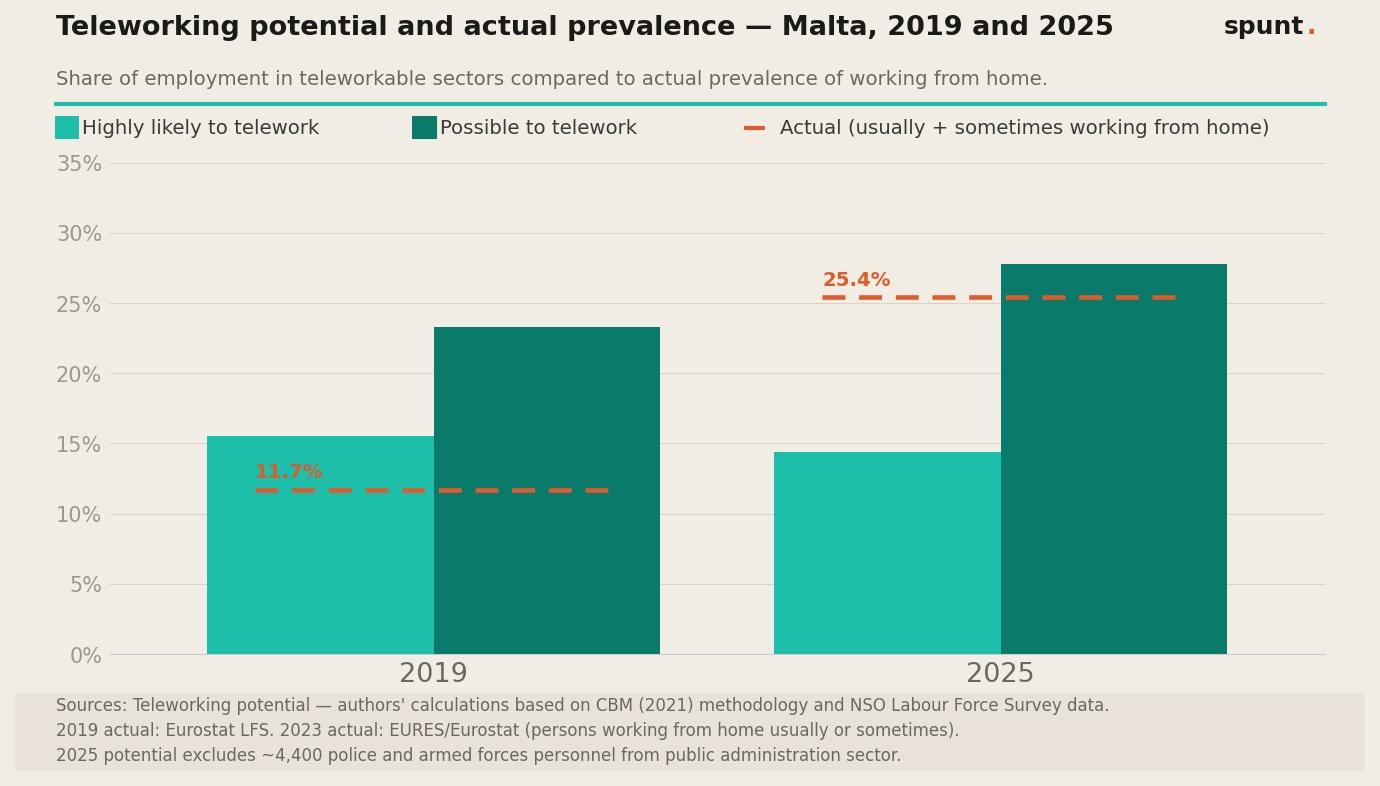
What is perhaps more striking than the potential is what has happened to the actual rate. Before the pandemic, only 11.7% of Maltese workers did any work from home, which was below the EU average, and well below what the country’s industry structure would suggest was possible. By 2023, that figure had risen to 25.4%. Without any legislation, without any formal right to request, and without any government incentive scheme, Malta’s actual teleworking rate had more than doubled, and now sits just below the upper bound of what our analysis suggests is realistically achievable.
The market, in other words, got here largely on its own. The pandemic forced a shift that employers and employees then chose, in substantial numbers, to maintain. This context is essential for evaluating what either party is now proposing.
A reform for whom?
Here lies the sharpest question the political debate is not asking.
The 25% of workers which are already teleworkable jobs are, almost without exception, professionals in knowledge-economy sectors which would include accountants, analysts, software developers, lawyers, financial services staff and gaming industry employees. These are the workers who, by and large, have already benefited from the post-pandemic shift to hybrid working. They are also, not coincidentally, the demographic that tends to vote in higher numbers, follow political debate more closely, and respond more strongly to work-life balance messaging.
The other 75% of Malta’s workforce where you have the construction worker, the nurse, the hotel receptionist, the warehouse operative, the retail assistant, the delivery driver, these workers cannot telework. The nature of their work requires physical presence. No legislative right to request remote working changes that reality. For these workers, the entire debate is conducted in a language that does not apply to them.
This is not a minor caveat. It is the central structural problem with the way both parties have framed their proposals. When Abela announces a right to request remote working as a headline pledge at a Workers’ Day rally, he is, in practice, announcing a measure that is relevant to fewer than one in six workers in the crowd. When Borg proposes a four-day week pilot in the public sector, he is proposing something that could, in principle, benefit a broader group, but only if the model is genuinely about reduced hours rather than compressed ones, and only if it is designed with care around the many public sector roles that require continuous service delivery.
Industry’s hesitancy in response to both sets of proposals is understandable, and not only on flexible working. The broader package of labour market measures which covers extended maternity leave to twenty-six weeks, paternity leave doubled to one month, six months of shared parental leave, risks creating genuine planning and cost challenges, particularly for Malta’s predominantly small and medium-sized businesses. A company with five employees absorbing a six-month parental leave absence is in a structurally different position from a multinational managing the same across a workforce of thousands. The government’s pledge to fund the shared parental leave element partially addresses this concern, but the implementation details will determine whether the relief is real or notional.
Abela’s right to request is not nothing. It imposes a legal obligation on employers to seriously consider the request and provide valid reasons in case of refusal. A refusal would typically be on grounds of added expenses, negative impact on clients, or lack of staff. On the right to request remote working specifically, the argument that the measure creates unacceptable burden is difficult to sustain given that Malta’s actual teleworking rate has already reached 25.4% which has been overwhelmingly driven by private sector adoption.
Our analysis suggests that around 9,400 workers are employed in sectors fully compatible with remote working and yet report no teleworking whatsoever. This gap is unlikely to be explained by the nature of the work itself since these are, by definition, jobs that can be done from home. It is more plausibly explained by firm-level culture, managerial reluctance, or simply the absence of a formal mechanism through which employees can raise the question. This is precisely the gap that a right to request is designed to close. For most of the workers it reaches, it would formalise what the market has already delivered, that is, a meaningful but considerably more modest achievement than the headline pledge suggests.
What the international evidence shows
The right to request flexible working is not a novel idea. The United Kingdom introduced it in 2003, initially for parents, and extended it to all employees in 2014. The 2023 Employment Relations Act made it a day-one right, removing the requirement for employees to explain how their request would affect their employer. The evidence from two decades of UK experience is instructive: the right to request has improved access to flexible working at the margins, but it remains only a right to have a request considered and not a right to receive what is asked for. Employers can refuse on any of eight permitted business grounds. The procedural strengthening has been real; the substantive change has been more limited.
At EU level, a 2019 Directive already obliges all member states (including Malta) to give working parents of children up to eight years old the right to request flexible working arrangements. The extent to which this has been transposed and enforced in Malta is itself a question worth asking before new legislation is layered on top.
On the four-day week, the international evidence is more genuinely encouraging but also more context-dependent than the headline figures suggest. Iceland’s trials between 2015 and 2019, involving around 2,500 public sector workers, found that productivity was maintained or improved in the majority of workplaces, worker wellbeing increased significantly, and burnout and sick days fell sharply. Following the trials, union negotiations led to reduced working hours becoming standard for around 86% of Iceland’s workforce. The UK’s 2022 pilot, involving over sixty companies, found that 92% of participating firms chose to maintain the four-day model after the trial. Portugal’s government-backed trial reported high employer approval and reduced fatigue.
But three things are worth noting. First, all of these trials were concentrated in knowledge-economy, office-based organisations which are the same 14% of Malta’s workforce already identified as teleworkable. Nobody has convincingly trialled a four-day week in hospitality, construction, retail, or healthcare at scale.
Second, the research is clear that success depends heavily on redesigning work processes, not simply compressing or removing hours. Trials that fail to do this report weaker outcomes and sometimes increased strain. Third, Iceland is not Malta. Iceland’s labour market is overwhelmingly unionised, its public sector is large and well-resourced, and its trial was developed over years with careful academic oversight. A pilot announced during an election campaign is a different thing.
Borg himself has been candid about the limits of his proposal. His intention, he has said, is to instigate a debate rather than impose a policy; “we will seek dialogue, not imposition.” That is a reasonable starting position. It is also, frankly, not very different from Abela’s pledge to open a discussion with social partners. Both leaders are proposing processes. Whether either process leads to meaningful change will depend on what happens after the votes are counted.
The conversation worth having
None of this is to say that flexible working reform is unimportant. The evidence from other countries suggests that well-designed flexibility measures improve wellbeing, reduce burnout, support gender equality in the labour market, and can maintain or improve productivity. Malta’s post-pandemic experience confirms that where flexibility is feasible, workers and employers have largely embraced it without being told to.
There is also a broader context that the debate has largely ignored. Malta’s economic growth has been driven overwhelmingly by expanding the labour force, a process of importing workers to meet rising demand, rather than by making existing workers more productive. As Maltese workers earn more, they are becoming less preoccupied with meeting their bills and increasingly concerned about quality of life, their environment, and the time they spend in it. This is a healthy and understandable shift. But a four-day week model that simply reduces hours without redesigning how work is done would require yet more workers to maintain the same level of output which would deepen Malta’s dependence on imported labour, compound the pressures of overpopulation, and add cost to the private sector. The conversation about flexible working cannot be separated from the conversation about productivity.
The more pressing question, and the one neither party has seriously engaged with, is what improved working conditions look like for the majority of Maltese workers for whom remote working and four-day weeks are simply not on the table. The construction worker dealing with summer heat. The nurse working rotating shifts. The hospitality worker whose job disappears entirely if the business closes on Fridays. These workers also deserve a serious conversation about their working conditions, their leave entitlements, and their work-life balance. They are just unlikely to find it in the current debate.
Malta is, by the evidence, already close to exhausting what the market can deliver on flexible working on its own. A right to request is a starting point, not a destination. A four-day week pilot, if designed carefully and evaluated rigorously, could generate evidence worth having. But presenting either as a transformation of Maltese working life requires a degree of honesty about who is and who is not in the room.
There is an uncomfortable irony in the private sector’s position. Productivity is not maintained solely by workers, but also by investing in technology, an area where the Maltese private sector stubbornly lags behind the EU, with investment intensity at 19% of GDP in 2023, below the EU average of 22%. For those workers already in teleworkable roles, technology is precisely what makes flexible arrangements viable through better tools, cloud infrastructure, and digital workflows reduce the friction that makes employers hesitant. For those in roles that require physical presence, the same investment can reduce labour intensity, cut repetitive tasks, and make the case for compressed hours considerably more credible. A private sector that resists both is not defending operational necessity. It is defending inertia.
Data: Spunt analysis based on Central Bank of Malta (2021) methodology and NSO Labour Force Survey. Actual teleworking rates: Eurostat LFS (2019) and EURES/Eurostat (2023).