
Governor Congreve is buried at sea off Filfla
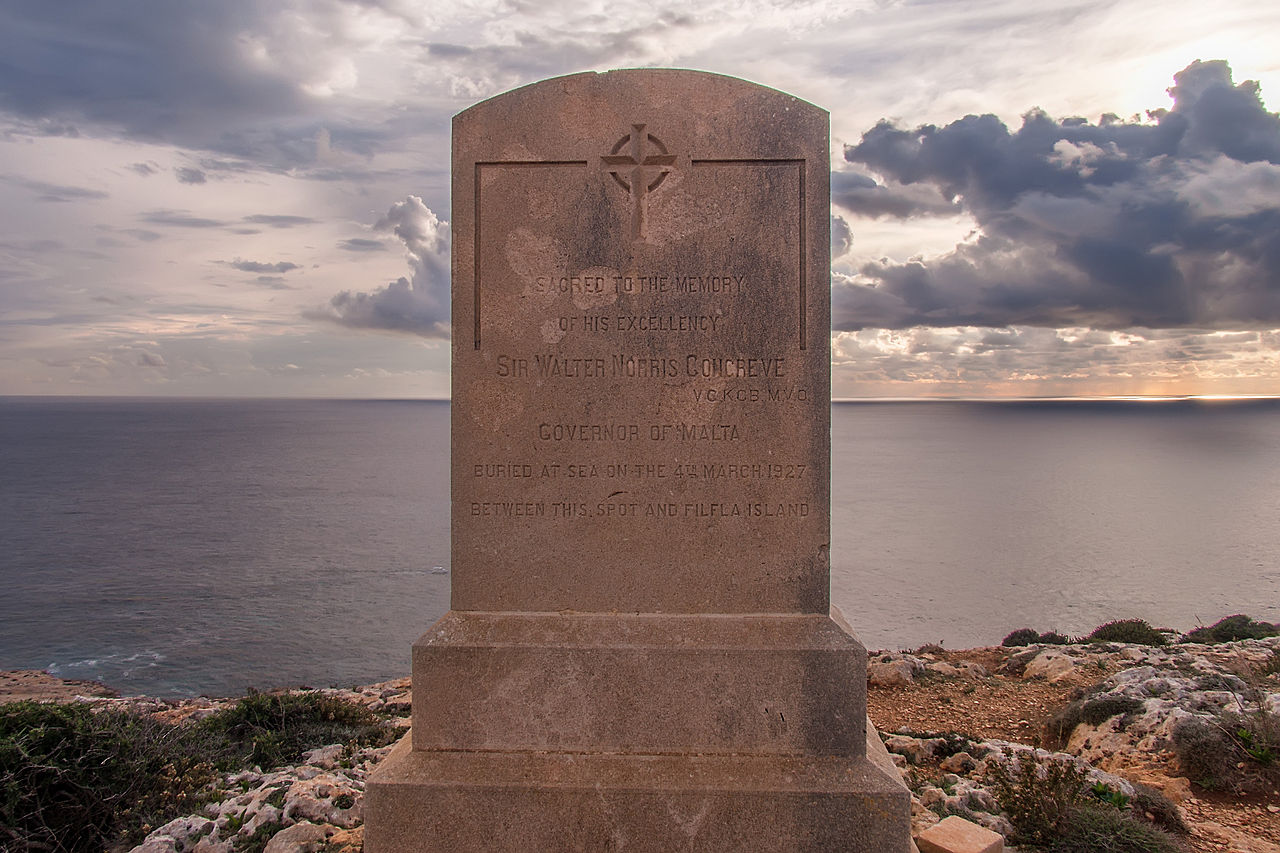
Filfla is one of Malta’s smallest wild outposts, a stark, protected islet sitting quietly on the southern horizon, familiar to anyone who’s ever looked out from the cliffs. But on 4 March 1927, the water between Malta and Filfla became the final resting place of the island’s sitting Governor, General Sir Walter Norris Congreve. In line with his last request, he was buried at sea from HMS Chrysanthemum, in the channel off the south coast.
Congreve was not a typical ceremonial figure. Before Malta, he had built a reputation as a career British Army officer and a Victoria Cross recipient, for his actions at Colenso in December 1899, when he was among the men who tried to recover abandoned artillery guns under intense fire. Later, in World War I, he lost his left hand in 1917 and wore a prosthetic, which is why Maltese sources note the nickname “t’idu ganċ” (“arm with a hook”).
He served as Governor of Malta from 1924 until his death in office in 1927.
Rather than being laid to rest in a cemetery or a church, he chose the sea, specifically the stretch between the mainland and Filfla, turning a patch of open water into a named memory.
That decision also anchored him to a very Maltese geography. The channel between Malta and Filfla is often referred to as the Congreve Channel, and it sits beneath the same dramatic coastline that frames some of the island’s most iconic prehistoric sites. His memorial was later placed on the cliff edge near Ħaġar Qim, a physical marker on land pointing toward a grave that cannot be visited, only looked out over.
Filfla also puts the burial in context. Long after 1927, the islet was progressively locked down: declared as a bird reserve in 1980, given statutory nature-reserve protection in 1988 to tighten access and use, and later brought into Natura 2000 in 2004. So Congreve’s burial site isn’t just offshore, it lies beside a place Malta has since chosen to keep strictly protected and largely undisturbed.